
Peru is a South America country. It is famous for Machu Picchu, an ancient Incan city high in the Andes mountains. A portion of the amazon rain-forest also falls in the Peru border.
The region around Machu Picchu, including the Sacred Valley, Inca Trail and colonial city of Cusco, is rich in archaeological sites. Peru’s capital Lima is well known for the pre-Columbian art collections and a preserved colonial site.
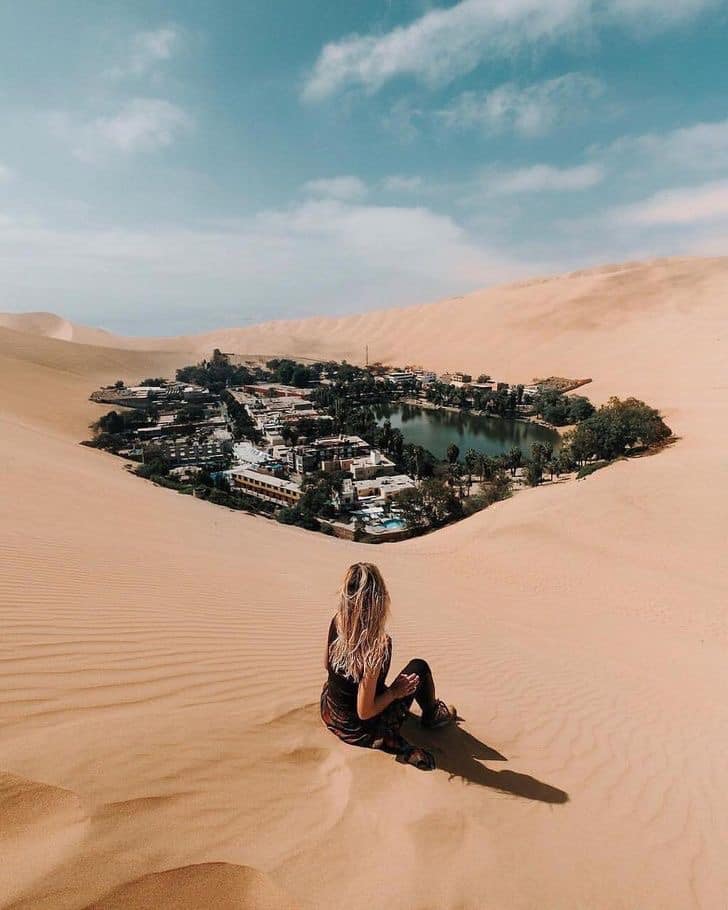
Huacachina is a stunning village in southwestern Peru, famous for being the only natural desert oasis in South America. It is centered around a lush, emerald-green lagoon and surrounded by some of the tallest sand dunes on the continent (reaching up to 500 meters high).
Here is a breakdown of what makes this “Oasis of America” so special:
- Legend and Lore
The name Huacachina comes from the Quechua word wakachina, meaning “hidden lagoon” or “weeping woman.”
The Mermaid Legend: Local myth says the lagoon was created by the tears of a beautiful Incan princess mourning the death of her lover.
The Mirror: Another version says she was startled by a hunter while looking into a mirror; she fled, and the mirror shattered to become the lake, while the folds of her mantle became the sand dunes. Legend has it she still lives in the lagoon as a mermaid.
- Top Activities
Huacachina has evolved from a 1940s luxury spa resort into a global hub for adventure travelers:
Dune Buggies (Areneros): Professional drivers take you on a high-speed “rollercoaster” ride across the desert. It’s widely considered the highlight of any visit.
Sandboarding: Most buggy tours include stops where you can slide down massive dunes on boards—either standing up (for pros) or face-down on your belly (the most common way).
Sunset Hikes: Hiking to the top of the dunes to watch the sun sink over the horizon is a “bucket list” experience for photographers.
Pisco & Wine Tours: Since Huacachina is just minutes from the city of Ica, it’s the perfect base to visit historic vineyards like Tacama to taste Peru’s national spirit, Pisco.
- Essential Travel Tips
Location: It is about a 4.5 to 5-hour bus ride south of Lima. Most people visit as part of a “Peru Hop” bus route or a long day trip.
Climate: It’s warm and sunny year-round. The “summer” (November–March) can get very hot (30°C+), while the winter nights (June–August) can be surprisingly chilly.
The Lagoon: While it was originally fed by underground aquifers, the water level is now artificially maintained by pumping water in to prevent it from drying up due to local well-drilling.
Health Warning: While the lagoon was once believed to have healing properties for ailments like rheumatism, the water today is generally not considered clean enough for swimming. Stick to paddle boats or the pools at the local hostels.
- Vibe and Nightlife
Huacachina is tiny—you can walk around the entire lagoon in about 15 minutes. It has a high-energy, “backpacker” atmosphere with plenty of hostels (like Banana’s Adventure or Wild Rover), rooftop bars, and restaurants lining the boardwalk.


If Huacachina is Peru’s desert oasis, Moray is its high-altitude scientific wonder. Located in the Sacred Valley near Cusco, it is one of the most visually striking and intellectually fascinating Inca sites.
1. The “Agricultural Laboratory”
Moray consists of several massive, circular terraced depressions (called muyus). While they look like ancient Greek amphitheaters, archaeologists believe they served as a sophisticated agricultural research station.
- Microclimates: The depth and orientation of the terraces create a temperature difference of up to 15°C (27°F) between the top and the bottom.
- Simulation: This allowed the Incas to simulate different ecological zones (from the warm lowlands to the freezing highlands) in a single location to see which crops—like corn, quinoa, and potatoes—grew best at different altitudes.
- Imported Soil: Soil samples show that the Incas actually transported earth from different regions of the empire to these specific terraces to further refine their experiments.
2. Engineering Brilliance
The landscape of Moray isn’t just about the terraces; it’s a masterclass in ancient engineering:
- Drainage: Even during the heaviest Andean rains, the bottom of the “bowls” never floods. The Incas built a complex underground drainage system of rocks and sand that filters water into the natural porous rock below.
- Irrigation: Water was channeled from mountain reservoirs via stone-carved canals that still exist today.
- Acoustics: Due to its circular shape, the site has incredible natural acoustics, leading some to believe it also served a ceremonial or ritual purpose.
3. The Landscape Experience
- Altitude: Perched on a high plateau at 3,500 meters (11,500 feet), the site offers panoramic views of the snow-capped Vilcanota mountain range.
- Contrast: In the rainy season (November–March), the terraces are a vibrant, lush green. In the dry season (May–October), the landscape turns a golden, arid brown, highlighting the sharp geometry of the stone walls.


Travel Equipment
Travel Equipment is the place to find all of your travel related questions. We had covered the best Backpack, Travel Tents, Travel Gear and other gadgets for a safe and secure journey.


0 Comments